
The Drainage Mistakes That Kill Retaining Walls
Almost every failed retaining wall we inspect failed for one of two reasons, and neither of them is the block. Water and base preparation decide whether a wall lasts.
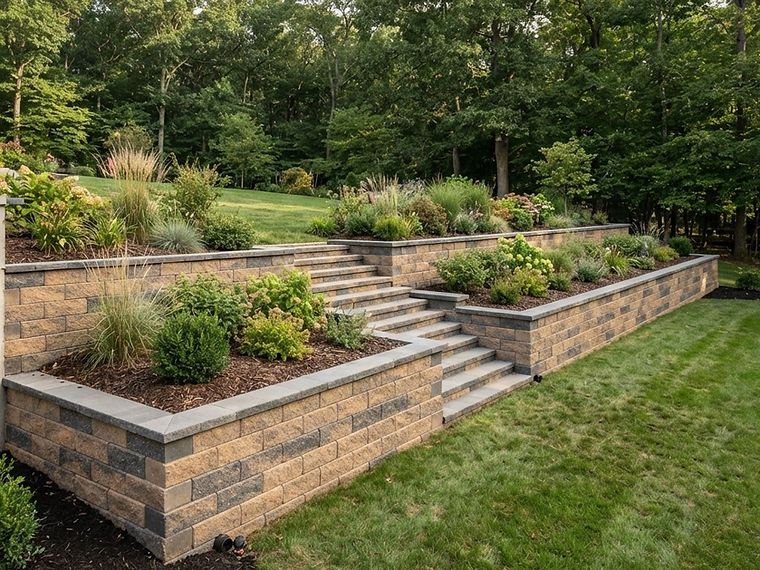
A retaining wall is a structure, not a landscape feature. It is holding back soil, and soil is heavy. Add water to that soil and the load on the wall increases dramatically, because saturated soil behaves much more like a liquid than a solid.
That is the whole story behind most wall failures. The wall itself is rarely the weak point. The problem is what is happening behind it and underneath it, and both of those are decided before the first block is ever laid.
Water Is the Load Nobody Plans For
Dry soil exerts a lateral push on a wall. Saturated soil exerts a much larger one, because water occupies the spaces between particles, adds weight, and reduces the friction that holds soil in place. When water cannot drain away, it accumulates behind the wall until the pressure becomes more than the structure was designed to resist.
Then winter arrives. Water trapped behind a wall freezes and expands, and the expansion pushes the wall forward. It thaws, the wall may settle back slightly, and then it freezes again. Over a few seasons the wall has crept outward and the joints have begun to open. This is the single most common failure pattern we see.
The Drainage Details That Actually Matter
Effective drainage is not a single product, it is a system, and it has to be built in during construction. Behind the wall goes clean drainage stone, which allows water to move downward freely instead of building pressure. At the low point of that stone goes a perforated pipe, which collects the water and carries it somewhere safe. Around the stone goes filter fabric, which keeps fine soil from washing in and silting the system closed over time.
That perforated pipe has to daylight somewhere. If it terminates inside the backfill or dead-ends against a foundation, the water simply collects at the bottom of the wall instead of behind it, which is a different version of the same problem. A wall draining into a low spot at its base is still a wall holding saturated soil.
A wall built without any of this may look perfect for two or three years. It will then start to lean, and by the time it is visibly out of plumb the correction is expensive.
- Clean drainage stone the full height of the wall face, not just at the base
- Perforated pipe at the lowest point of the drainage zone
- Pipe daylit or tied to a drainage outlet, never dead-ended
- Filter fabric between the stone and the retained soil
- Weep holes or face openings where the wall system calls for them
- Capstone set with adhesive to shed water off the top course
Base Preparation Is Where Walls Are Won
The second failure category is an inadequate base. A wall set on graded soil, or on a base course that was dumped and compacted only at the surface, begins to settle unevenly. Once one course drops, every course above it follows, joints open, and the top of the wall develops a wave.
Proper base work means excavating to stable subgrade rather than stopping at a convenient depth, removing unsuitable material, then building up granular base in shallow lifts and compacting each lift. The first course is set level and true, because everything above inherits that geometry, and correcting it later means dismantling the wall.
Wall embedment is part of this. The bottom course has to be buried deep enough that soil in front of it prevents the wall from sliding forward under load. A wall sitting on the surface with no embedment is relying entirely on friction, and friction is exactly what saturated soil takes away.
Height, Load and Geogrid
As a wall gets taller, the load it resists grows quickly. A low garden wall and a wall holding up a driveway are different engineering problems, even if they use the same block. Once a wall exceeds certain height or load thresholds, it needs reinforcement tying the block face back into the retained soil.
Geogrid is the standard solution. Layers of grid are placed between courses and extend back into the soil, so the wall and the soil behind it behave as a single reinforced mass rather than a face holding back a moving pile. Without it, a tall wall is relying on block weight alone to resist a load that will eventually exceed it.
Higher walls also commonly trigger a permit requirement, and sometimes a stamped plan. That threshold varies by municipality, and we flag it at the estimate stage rather than after excavation begins.
Signs a Wall Is Already Failing
A wall leaning away from the soil it retains is the obvious sign, but it is usually not the first one. Look for horizontal cracks running along a course, joints opening on the face, a top course that has begun to step out of alignment, or soil visibly bulging above the wall.
Settlement is the other early indicator. A wall that has dropped slightly at one end, or a capstone that has separated from the courses below, is telling you the base is moving. Water staining on the face after rain, or a persistent damp patch, suggests drainage is not functioning.
If a wall is failing, repairing the face alone will not help. The correction has to address the base and the drainage, which usually means dismantling and rebuilding. In many cases the block itself is still sound and can be reused, which lowers the cost of putting the structure right.
Common questions
Related guides

 Fence Repair
Why Fence Posts Lean After Winter
A post that leans after a hard winter is telling you about the ground, not the fence. Here is what actually happens below grade and what fixes it for good.
Read Article
 Permits & Planning
Do You Need a Permit for a Fence in Bergen County?
There is no single fence rule for Bergen County. Height limits and setbacks are set town by town, and the pool barrier requirement sits on top of both.
Read Article
 Driveways
Asphalt Driveway Care Through New Jersey Seasons
Water is what ends an asphalt driveway's life, and New Jersey gives it plenty of chances. Here is the maintenance that genuinely extends the surface.
Read ArticleSchedule an on-site visit
We serve every Bergen County community plus Passaic, Morris, Essex, Hudson, Hunterdon, Somerset and Union County, and the New York metro area.
Built to outlast the weather
Custom fencing and exterior construction for Northern New Jersey, backed by a written workmanship warranty and two decades in the same communities.