
Asphalt Driveways Paved to Perform Through New Jersey Winters
Correct sub-base, real compaction and grading that sends water where it belongs instead of into your driveway.
Licensed | Bonded | Insured
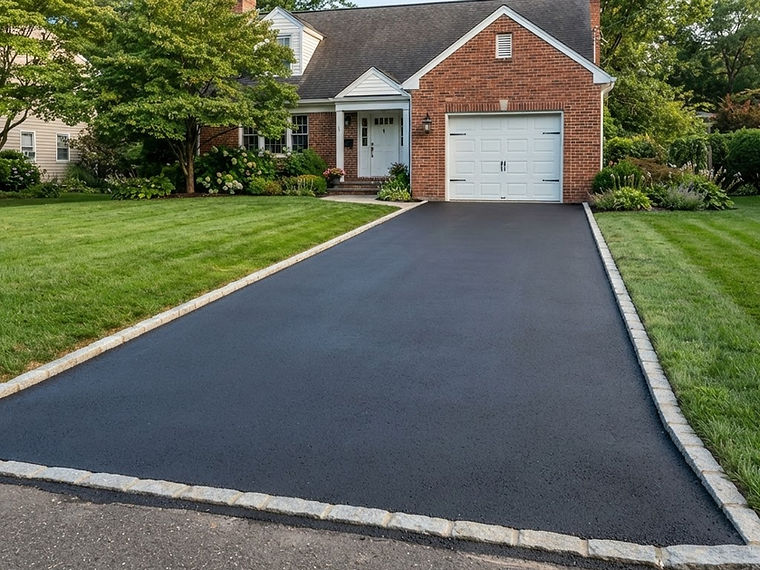
An asphalt driveway is only as good as what is under it. The black surface is the visible part, but the sub-base, the grading and the compaction beneath it determine whether you are looking at a smooth, stable driveway in ten years or a web of cracks, ruts and puddles. This is why two driveways quoted at very different prices are rarely comparing the same scope of work.
City Fence LLC installs and replaces asphalt driveways across Northern New Jersey. We excavate to a stable subgrade, build a properly graded and compacted stone base, and place hot mix asphalt at the right thickness in the right temperature conditions. Water flow is designed rather than discovered, which matters enormously in a region where spring thaw and heavy summer storms test every driveway on the block.
- Full-depth installation with excavated, compacted stone sub-base
- Grading designed for positive drainage away from the foundation
- Hot mix asphalt placed at proper thickness and compacted in lifts
- Aprons, transitions and edge details built to hold their shape
What our asphalt driveways service includes
Everything below is included in a standard project. Anything outside this list is quoted separately so there are no surprises on the invoice.
- On-site evaluation of existing surface, sub-base condition and drainage
- Excavation of unsuitable material and full-depth base preparation
- Graded and compacted crushed stone base built to proper thickness
- Geotextile fabric where subgrade soils require separation
- Hot mix asphalt placed and compacted in lifts to specified thickness
- Driveway aprons, transitions to garage and curb tie-ins
- Drainage swales, pitch correction and water diversion
- Edge trimming, cleanup and guidance on cure time and sealing
What we work with
We install and repair every major system, so the recommendation you get is based on your property rather than on what we happen to stock.
Hot Mix Asphalt
Applied while hot and compacted immediately, which is what allows the aggregate to interlock and form a dense, durable surface rather than a loose mat.
Crushed Stone Base
Properly graded, angular crushed stone compacted in lifts. It carries the load and drains water away from the subgrade so the surface does not fail from beneath.
Geotextile Separation Fabric
On fine or unstable soils, fabric keeps base stone from migrating downward into the subgrade, preserving base thickness over the life of the driveway.
Edging & Transition Details
Steel or stone edging, garage transitions and apron detailing that prevent the edges of the asphalt from raveling under tire load.
Grading and Base Preparation
The first thing we establish is what the existing driveway or subgrade is made of. If soft or organic material is present, it comes out. If the subgrade is fine-grained or unstable, we separate it with geotextile fabric so the stone base does not migrate into the soil underneath. What remains is a stable platform that will not settle unevenly under the weight of vehicles.
We then build up crushed stone in layers and compact each one rather than dumping the full base depth and compacting the top. Compaction in lifts is slower and it is the difference between a base that is dense throughout and one that is only dense at the surface. Grading is set at the same time, establishing the fall the finished driveway needs so water moves away from the house and off the surface.
Placement and Compaction
Asphalt is placed hot, raked or screeded to the correct profile, and compacted immediately with a roller sized to the work. Temperature matters more than homeowners realize. Asphalt placed when it is too cold does not compact properly and will be porous and short-lived; too thin and it will crack under load. We work in the conditions the material needs rather than forcing a schedule.
Compaction is done to a specified density, which is what closes the surface and locks the aggregate together. The finished mat is dense, uniformly textured and free of segregation, where the larger stones separate from the mix and leave a rough, weak patch. We check grade and pitch as we go so the finished surface sheds water instead of holding it.
- Subgrade excavation and removal of unsuitable, soft or organic material
- Geotextile fabric on fine-grained soils to protect base thickness
- Crushed stone base compacted in lifts rather than a single pass
- Grading set for positive drainage before any asphalt is placed
- Hot mix placed at proper temperature, thickness and compaction density
- Surface checked for pitch, segregation and uniform finish
Aprons, Drainage and Water Flow
Driveway failures in Northern New Jersey are usually drainage failures. Water that ponds on the surface eventually finds its way into the asphalt, and water that freezes inside a driveway widens every crack it occupies. Our design goal is straightforward: get water off the driveway and away from the foundation as quickly as possible.
That involves setting the right longitudinal and cross slope, planning the apron transition at the street so the driveway meets the road without a lip or a low spot, and where necessary adding a swale or diversion to intercept runoff before it reaches the driveway. We also detail the transitions at the garage and any curb tie-ins, because those are the points where edges ravel first when the surface is undercut by water.
Sealing and How to Make Asphalt Last
New asphalt needs time before sealing, typically several months of curing, and it should not be sealed prematurely. Once cured, sealing at the right intervals protects the surface from water penetration and from the oxidation that turns asphalt grey and brittle. Sealing too often is wasteful; sealing never is how driveways develop surface cracking.
There are also things you can control yourself. Keeping heavy loads off the edges, avoiding turning the steering wheel while stationary on hot days, and clearing snow with a plastic-edged blade rather than metal all extend surface life. When we finish a driveway we walk you through realistic maintenance, including when to seal and what the first winter will look like.
How the project runs
- 01
Free on-site estimate
We walk the property with you, measure the actual run, check grade and drainage, and discuss how you want the space to function.
- 02
Clear written quote
You receive an itemized proposal covering materials, hardware, footings, removal and labor, with no hidden line items.
- 03
Permits and scheduling
We guide you through municipal permit requirements and survey needs, then lock in a start date that works for your household.
- 04
Professional installation
Posts are set to proper depth, lines are strung and leveled, and every panel, gate and surface is installed to specification.
- 05
Final walkthrough
We review the finished work together, confirm gate operation and site cleanup, and hand over your warranty documentation.
Asphalt Driveways town by town
Local ground conditions, common failures and municipal requirements vary. These pages cover the specifics for the communities we work in most.
Ridgewood, NJ
Bergen County
Exterior construction across Ridgewood: retaining walls, driveways, sidewalks and pavers, built on real base and drainage.
Wayne, NJ
Passaic County
Engineered retaining walls and terraced grade changes built for Wayne's sloped and lakefront properties.
Clifton, NJ
Passaic County
Asphalt driveway installation in Clifton built on proper base, with grading designed for real water flow.
Montclair, NJ
Essex County
Brick and concrete paver patios, walkways and driveways for Montclair's older homes and tight lots.
Parsippany, NJ
Morris County
Concrete sidewalk replacement and repair in Parsippany, including lifted panels and trip hazards.
Asphalt Driveways questions
Often paired with this work

 01
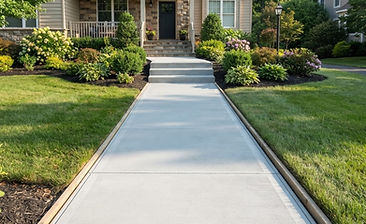
Concrete Sidewalks
Concrete sidewalk installation built for safety, longevity, and compliance with local standards.
View Service
 02
Brick Pavers
Brick paver installation for patios, walkways, and driveways, offering strength, functionality, and a clean finish.
View Service
 03
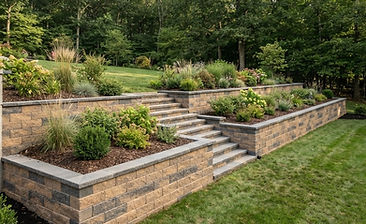
Retaining Walls
Retaining wall construction designed to control erosion, support landscaping, and improve the structure and appearance of outdoor spaces.
View ServiceGet a written quote for your project
We quote after seeing the site, because linear footage, terrain and access change the number. No obligation, no pressure.
Ready for a straight line and a solid footing?
Tell us what you are building, repairing or replacing. We will walk the property, measure the actual run and give you a written quote with no obligation.