
General Contractor in Ridgewood, New Jersey
Retaining walls, driveways, sidewalks and paver surfaces built on real base, with grading and drainage designed before the first load arrives.

- Focus
- General contracting
- Core Work
- Walls, asphalt, concrete, pavers
- Serving Ridgewood
- Since 2006
Ridgewood is a village of mature properties, established landscaping and terrain that rarely cooperates. The streets climb away from the Ho-Ho-Kus Brook, the lots are graded for drainage that was designed decades ago, and the housing stock carries a lot of exterior work that has been in place long enough to need rebuilding. That combination creates a specific kind of construction project, where the surface you see matters less than the base, the pitch and the water management underneath it.
City Fence LLC works as a general contractor on exterior work throughout Ridgewood, building retaining walls, asphalt driveways, concrete sidewalks, steps and brick paver patios and walkways. We also install and repair all six fence systems, which means we can handle the retaining wall, the driveway apron and the fence line around the same property without you having to coordinate three separate contractors and hope their work meets. This page explains how we approach construction work in Ridgewood specifically, and what to expect from an estimate through to a finished, level surface.
Why Exterior Construction Fails in Ridgewood
Almost every failing driveway, cracked sidewalk or leaning wall we inspect in Ridgewood fails for one of two reasons: the base beneath it was never built to carry what sits on top, or water was left with nowhere to go. Both problems are invisible on the day the work is finished, which is exactly why they get skipped by contractors working to a low price.
The village's terrain makes the water problem worse than it would be on flat ground. Properties on sloped streets receive runoff from above, and if that water is not intercepted and directed, it will find the lowest point on the property, which is usually a driveway apron, a garage threshold or the back of a retaining wall. In a region that freezes and thaws repeatedly through the winter, water that sits in the wrong place becomes an excavating tool. Our approach is to understand where water moves across your property before designing anything that has to withstand it.
Retaining Walls Built to Hold, Not Just to Look Solid
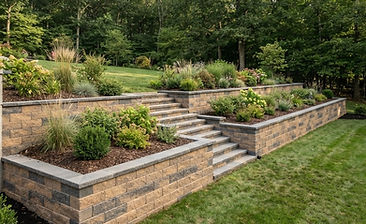
A retaining wall is a structure, and it is judged by how it performs after ten years of freeze-thaw cycles and saturated spring soil. The walls we are called to replace in Ridgewood almost always failed from hydrostatic pressure, the force of water trapped in the soil behind the wall, combined with a base that was not compacted in lifts. Once the bottom course settles, every course above it follows and the capstones begin to open.
We build the opposite way. Base excavation goes down to stable subgrade with unsuitable material removed, and the granular base is compacted in shallow layers rather than dumped and compacted once. Behind the wall we install clean drainage stone, a perforated pipe at the low point day-lighted to a safe outlet, and filter fabric so fine soil cannot silt the stone and clog the system over time. On taller walls and walls carrying a driveway or structure above them, we add geogrid reinforcement that ties the block into the retained soil so the wall behaves as one reinforced mass rather than a stack of units.
- Excavation to stable subgrade with soft or organic material removed
- Granular base compacted in lifts, verified level before the first course
- Drainage stone, perforated pipe and filter fabric installed behind the wall
- Geogrid reinforcement for taller walls and walls carrying loads above
- Capstone set with adhesive joints so the top course sheds water
Driveways: Grading Is the Whole Job
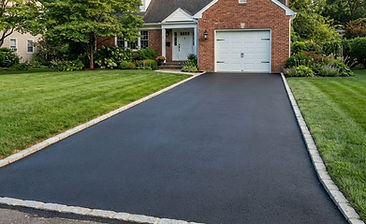
An asphalt driveway is only as good as what is under it. The black surface is the visible part, but the stone base, the compaction and the grading beneath determine whether you are looking at a smooth driveway in ten years or a web of cracks with water standing in the low spots. Ridgewood driveways face an additional challenge because many of them slope toward the house or toward a garage that sits below street grade.
We excavate to a stable subgrade, separate fine-grained or unstable soils with geotextile fabric where needed, and build the crushed stone base in compacted lifts. Grading is set before any asphalt is placed, establishing the fall the finished driveway needs to move water away from the foundation and off the surface. Asphalt is placed hot and compacted immediately at the right temperature, because material placed too cold never compacts properly and will stay porous for its whole service life. The transitions at the garage and at the street apron get particular attention, since those are the points where edges ravel first when water undercuts the surface.
Concrete Sidewalks, Steps and Accessibility
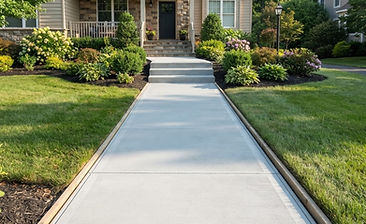
Concrete work in Ridgewood is often governed by municipal standards, particularly where a sidewalk sits in the public right of way or connects to a curb. Requirements for width, slab thickness and joint spacing vary, and inspection is common. We build to those standards with pre-formed, precise lines and set the pitch so water leaves the surface rather than standing on it and scaling through the winter.
The details that decide whether a sidewalk lasts are the joints. Concrete shrinks as it cures and it will crack, so control joints are placed at planned intervals to direct that crack somewhere invisible, with expansion joints at fixed objects such as steps, walls and existing slabs. We also air the mix properly, because entrained air is what gives concrete room to expand when water inside it freezes. A walkway that was poured level instead of pitched, or poured without adequate air content, will show surface scaling within a couple of winters.
Brick Pavers for Patios, Walkways and Driveways
Pavers are the most repairable hardscape surface available, which is precisely why the base matters so much. Individual pieces can be lifted and reset if a section settles or a utility line needs to be dug up, so a properly built paver surface survives the events that destroy a rigid slab. Built on an inadequate base, the same patio ruts, shifts and opens at the joints within a season or two.
Base depth is set by what the surface must carry, and a driveway that takes vehicles needs substantially more than a garden walkway. We excavate to the required depth, compact the crushed stone in lifts, and screed a bedding layer to the exact final plane. The perimeter gets rigid edge restraint or a soldier course, pinned correctly, because the field of pavers stays interlocked only if its edges cannot spread. Joints are finished with polymeric sand that resists washout, weeds and insect nesting rather than ordinary sand that disappears in a couple of seasons.
- Base excavated to application-specific depth for foot or vehicle loads
- Crushed stone compacted in lifts rather than a single pass
- Rigid edge restraint or soldier course around the full perimeter
- Layout set out on site so pattern start and finish lines read cleanly
- Polymeric joint sand swept, activated and cured for tight, stable joints
Coordinating Multiple Trades on One Property
The advantage of working with a single exterior contractor is sequencing. A Ridgewood property might need a retaining wall to create usable grade, a driveway rebuilt to a new pitch, a sidewalk replaced because the wall changed the transition at the curb, and a fence installed along the new property line. Handled by four different companies, each one works around the others and someone always inherits the previous trade's problem.
When we take on the whole scope, we sequence the work so each stage supports the next. The wall goes in first and establishes the grade the driveway and walk will meet. Drainage is designed once, for the whole property, rather than independently by each trade. Fence posts go in after the paved surfaces are finished, so footings are not disturbed by equipment working over them. That sequencing is not a premium service for us; it is simply the way the work goes together properly.
Permits, Surveys and the Municipal Process
Construction work in Ridgewood can trigger permit requirements depending on what is being built and where. Retaining walls above a certain height typically require a permit, and sometimes a stamped plan. Sidewalk work in the right of way is commonly inspected. Driveway aprons that touch the street often fall under the municipality's jurisdiction as well.
Permits are generally the property owner's responsibility, but we help you understand what your project is likely to trigger so there are no surprises mid-build, and we build to the approved plan. Where work sits near a property line, we flag it early so you can confirm the survey before excavation rather than after. Getting those questions answered before the first shovel goes in the ground is what keeps a construction project on schedule and on budget.
What an Estimate Covers
We quote after seeing the site, because exterior construction estimates built from a phone description are guesses. On site we assess the existing surface or structure, the condition of the subgrade, where water currently goes and where it will need to go after the work is complete. We measure the actual dimensions rather than working from an approximate footprint.
Your written proposal breaks the work into itemized lines: excavation, disposal, base material, surface material, drainage components, restoration and cleanup. Optional items are quoted separately so you can see exactly what changes the price. If we find something during excavation that changes the scope, we stop and talk to you before proceeding rather than absorbing it silently or presenting a surprise invoice at the end.
Ridgewood questions
What we build in Ridgewood
We handle the following work for Ridgewood homeowners and businesses. Each service has its own page with materials, process and code details.

 01
Retaining Walls
Retaining wall construction designed to control erosion, support landscaping, and improve the structure and appearance of outdoor spaces.
View Service
 02
Asphalt Driveways
Asphalt driveway installation services focused on durability, proper grading, and long-term performance.
View Service
 03
Brick Pavers
Brick paver installation for patios, walkways, and driveways, offering strength, functionality, and a clean finish.
View Service
 04
Concrete Sidewalks
Concrete sidewalk installation built for safety, longevity, and compliance with local standards.
View ServiceRelated work in neighboring towns
Wayne, NJ
Passaic County
Engineered retaining walls and terraced grade changes built for Wayne's sloped and lakefront properties.
Montclair, NJ
Essex County
Brick and concrete paver patios, walkways and driveways for Montclair's older homes and tight lots.
Hackensack, NJ
Bergen County
Custom fence installation in Hackensack, from privacy runs to pool barriers, built on footings that hold.
Schedule an on-site visit
We come out, walk the property, check the grade and measure the actual dimensions before quoting. Serving Ridgewood and the rest of Bergen County since 2006.
General Contractor in Ridgewood, done properly
Tell us what you are building, repairing or replacing in Ridgewood. We will walk the property, measure the actual run and give you a written quote with no obligation.