
Why Fence Posts Lean After Winter
A post that leans after a hard winter is telling you about the ground, not the fence. Here is what actually happens below grade and what fixes it for good.
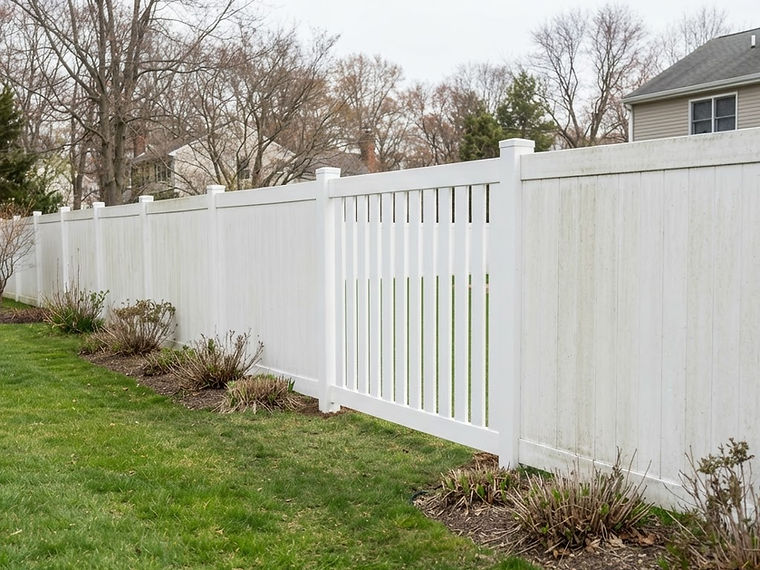
Every spring we get the same call: the fence was straight in October, and now one post is leaning and the gate will not latch. Nothing hit it, nothing rotted, nothing obvious changed. The post simply moved.
That movement is almost never about the fence. It is about the ground beneath it and how deep the footing was set. If you understand what happens under a post through a Northern New Jersey winter, you can predict which fences will fail and which repairs will actually hold.
Frost Heave, Explained Without the Engineering Lingo
Soil holds water. In late autumn that water sits in the ground around a fence post, and when temperatures drop far enough the water in the upper layers of soil freezes. Water expands as it freezes, which means the ground itself swells upward. That swelling is called frost heave.
Any footing sitting inside that freezing layer is pushed upward along with the soil around it. When the ground thaws, the soil settles back down, but the post often does not return to exactly where it started. Repeat that cycle across several winters and the movement accumulates. A post that lifted a quarter inch each year is a visibly crooked post after six or eight years.
The Frost Line Is the Whole Story
Below a certain depth, the ground does not freeze at all, even through a hard winter. That depth is the frost line, and it varies by region. In Northern New Jersey, frost penetrates deep enough that a footing set at a typical do-it-yourself depth sits squarely inside the freezing zone every single winter.
This is why two fences built on the same street in the same summer can behave completely differently. One was set below the frost line and stays put. The other was not, and it has been slowly lifting since the first January. There is no amount of re-plumbing or bracing that fixes the second fence, because the problem is not the angle of the post, it is the depth of the hole.
Why Bracing and Shimming Do Not Work
When a homeowner asks whether a leaning post can simply be straightened, the honest answer is that it depends on why it moved. If the cause was a one-time impact, such as a vehicle or a falling limb, the post can often be reset with no further trouble.
If the cause was frost, straightening it in place accomplishes little. Pushing the post back to plumb and filling the hole around it leaves the footing at the same shallow depth it was before, so it will lift again the next winter and you will be back where you started. Shimming the rail above a heaved post has the same result.
A brace or sleeve driven alongside a failed post is a temporary measure at best. It is a reasonable way to secure a gate that has become a hazard while you wait for materials, but it is not a repair, and it should not be sold as one.
What a Repair That Actually Holds Looks Like
The repair that works is unglamorous. The failed post is pulled out. A new hole is dug to a depth below the local frost line, and the bottom of the hole is widened so the concrete forms a bell shape that keys into undisturbed soil rather than sliding upward.
The new post is set in concrete, plumbed and braced while the concrete cures so it cannot drift. Where several posts in a run have heaved together, we treat them as a group, because resetting one post in a line that is otherwise moving produces a fence that looks just as crooked from a different angle.
Posts that carry gates and corners get extra attention, because they resist tension from more than one direction. A gate post is the most heavily loaded part of a fence, and it is the most common place for a shallow footing to fail visibly.
- Post extracted rather than straightened in place
- New hole dug below the regional frost line
- Hole widened at the base so concrete keys into undisturbed soil
- Post set in concrete, plumbed and braced until cured
- Whole run checked and moving posts reset as a group
- Corner and gate posts given deeper footings than line posts
Signs Your Fence Has a Footing Problem
A single post leaning is usually a footing issue. Several posts leaning in the same direction is a strong sign that none of them were set deep enough. A gate that drags or will not latch is often the first symptom, because a gate is the only part of a fence that has to work within tight tolerances.
You can check a post yourself without any tools. Push against it firmly at the top. A post with a proper footing feels like it is anchored to the ground and does not move at all. A post that rocks even slightly is already moving in its hole, and that movement will only get worse next winter.
Other reliable indicators include rails pulling away from posts at the fasteners, a fence line that no longer looks straight when viewed from the end rather than the front, and soil that has visibly mounded or settled around individual posts.
Fixing It Once
If your fence has one or two failed posts and the rest of the structure is sound, targeted repair is the right call and it is money well spent. If most of the run has been moving, the fence was built too shallow to ever hold, and piecemeal repair will become an annual expense.
We inspect every post in the affected run with a level, probe the material where it meets the ground, and tell you plainly which situation you are in. If replacement is the better value, we will say so rather than taking the repair and returning next spring.
Common questions
Related guides

 Permits & Planning
Do You Need a Permit for a Fence in Bergen County?
There is no single fence rule for Bergen County. Height limits and setbacks are set town by town, and the pool barrier requirement sits on top of both.
Read ArticleFence InstallationCedar, Vinyl or Aluminum: Choosing a Fence Material in New Jersey
The right fence material is the one that matches how you will actually use the yard and how much maintenance you are willing to do. Here is the honest comparison.
Read Article
 Retaining Walls
The Drainage Mistakes That Kill Retaining Walls
Almost every failed retaining wall we inspect failed for one of two reasons, and neither of them is the block. Water and base preparation decide whether a wall lasts.
Read ArticleSchedule an on-site visit
We serve every Bergen County community plus Passaic, Morris, Essex, Hudson, Hunterdon, Somerset and Union County, and the New York metro area.
Built to outlast the weather
Custom fencing and exterior construction for Northern New Jersey, backed by a written workmanship warranty and two decades in the same communities.