
Asphalt Driveway Care Through New Jersey Seasons
Water is what ends an asphalt driveway's life, and New Jersey gives it plenty of chances. Here is the maintenance that genuinely extends the surface.
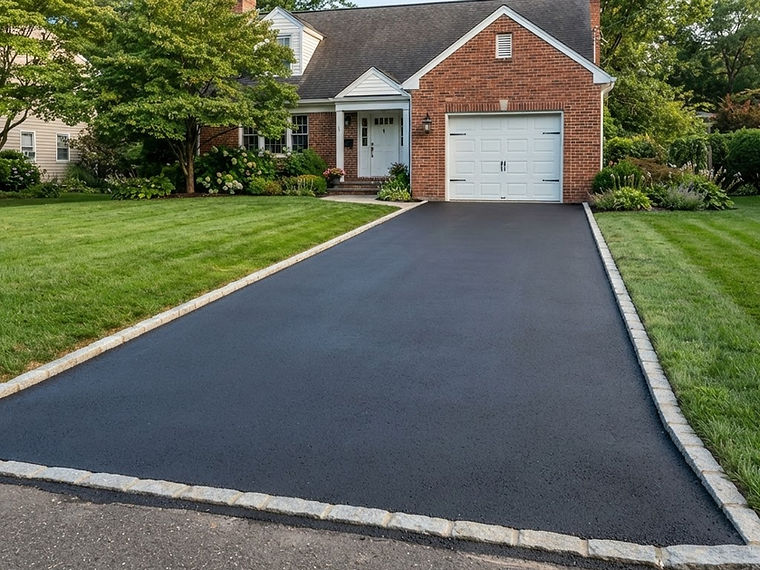
An asphalt driveway does not wear out from traffic. It wears out from water getting into it and then freezing. Everything useful you can do to extend a driveway's life is really about keeping water out and moving it away.
Here is what actually matters season by season, and the maintenance that is worth paying for versus the maintenance that is mostly a sales pitch.
Why Freeze-Thaw Is So Hard on Asphalt
Asphalt is a flexible surface over a rigid base, and it performs well as long as the base stays dry and stable. When water penetrates the surface through a crack or a porous area, it reaches the base underneath. When that water freezes, it expands and pushes the base material apart.
The following thaw leaves a void where the ice was. Traffic then compresses the surface into that void, enlarging the crack and letting more water in. Repeat that cycle through one winter and a hairline crack becomes a visible fault line. Do it for five winters and you have an alligator-cracked surface that cannot be saved by sealing.
Sealing: The Right Interval Matters More Than the Product
Sealing protects asphalt from water penetration and from the oxidation that turns it grey and brittle. It is genuinely worthwhile. It is also the most commonly oversold service in the industry, and sealing too often causes its own problems.
New asphalt needs time to cure before it is sealed, typically several months of warm weather, so the oils can evaporate properly. Sealing a driveway too early traps those oils and can leave the surface soft. After the first seal, a realistic interval is every two to four years depending on sun exposure, slope and how much the driveway is used.
A driveway that is sealed annually is not better protected, it is just being sold a service it does not need. Sealing a badly cracked, structurally failed driveway is also largely wasted money, since the water is already reaching the base through faults that sealing cannot close.
Cracks: Deal With Them Early and Properly
A crack is a water channel, so the goal is to close it before winter. Clean the crack out first, because sealant applied over dirt and loose aggregate will not bond and will simply lift out. Then fill with a proper crack filler rather than smearing leftover sealant across the top.
Long cracks that run across the driveway often point to an underlying issue, such as a failing base, a poorly supported edge or a drainage problem directing water at that spot. Filling the crack helps, but if the cause is drainage, the crack will reappear nearby. On driveways with widespread cracking, patching individual cracks is a delaying tactic and a full-depth repair or replacement is the honest recommendation.
- Clean cracks thoroughly before filling so sealant can bond
- Use proper crack filler rather than surfacing sealant
- Fill before the first freeze, not after
- Investigate cross-driveway cracks for base or drainage causes
- Treat widespread cracking as a sign that the base, not the surface, is failing
Edges and Water Flow
Driveway edges ravel first, because they are supported on only one side and they take the runoff from the surface. Once an edge breaks down, water gets under the asphalt along the whole length of that edge and the failure accelerates inward.
Keeping the surface crowned or sloped so water runs off rather than standing is the other essential. If you see standing water in the same spot after every storm, the pitch is wrong or the surface has settled, and every freeze in that puddle is widening the problem.
Runoff from uphill areas is worth intercepting before it reaches the driveway at all. A swale or a diversion higher up the property is far cheaper than rebuilding a driveway.
Winter Habits That Make a Difference
Use a plastic-edged shovel or a snow blower with a skid plate, and keep the blade raised slightly off the surface. Metal blades scraping asphalt across a whole driveway season do real damage, particularly on a young surface that has not fully cured.
Be careful with de-icing products. Rock salt is hard on asphalt and on the concrete of adjoining walks and steps. Sand provides traction without the chemical attack. And avoid parking heavy loads on the edges of the driveway, where the asphalt is least supported.
In spring, walk the driveway and look for new cracks and any spot where water pooled over the winter. Handling those in May is far cheaper than replacing a whole surface in a few years.
Common questions
Related guides

 Retaining Walls
The Drainage Mistakes That Kill Retaining Walls
Almost every failed retaining wall we inspect failed for one of two reasons, and neither of them is the block. Water and base preparation decide whether a wall lasts.
Read Article
 Fence Installation
Cedar, Vinyl or Aluminum: Choosing a Fence Material in New Jersey
The right fence material is the one that matches how you will actually use the yard and how much maintenance you are willing to do. Here is the honest comparison.
Read Article
 Hiring & Planning
How to Vet a Fence or Construction Contractor in Northern NJ
Most of the difference between a good and a bad contractor shows up in the quote and in two questions you can ask before anyone digs a hole.
Read ArticleSchedule an on-site visit
We serve every Bergen County community plus Passaic, Morris, Essex, Hudson, Hunterdon, Somerset and Union County, and the New York metro area.
Built to outlast the weather
Custom fencing and exterior construction for Northern New Jersey, backed by a written workmanship warranty and two decades in the same communities.